CUSCO
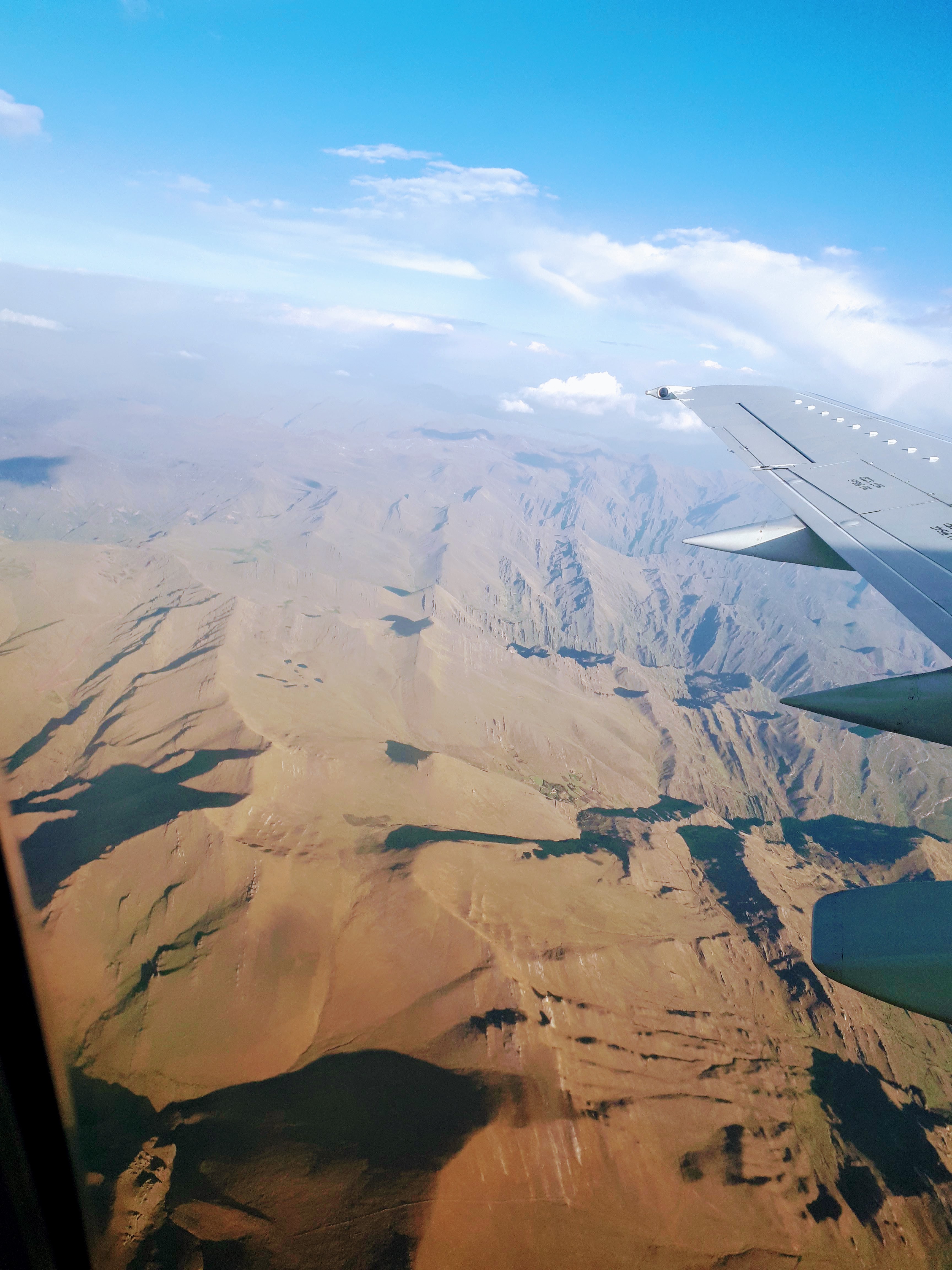
Today we flew early from Lima to the mountain city of Cusco. The descent to Cusco through the mountains is utterly breath taking and I experienced a giddy excitement as I peered over the shoulder of a pretty young Peruvian woman to gawp out of the small airplane window. She was smiling at my enjoyment of the scenery and shrinking back against her seat so that I could get a better look.
I had read that Cusco airport operates at a limited capacity with particular challenges for landing and take-off. From the landing point of view, the pilot has to steer the plane between the magestic ridges of the Andes on either side which stretch off interminably as far as the eye can see. The Andes are 4300 miles long and up to 430 miles wide as they march through seven South American countries and their scale and magnificence is a sight to behold from the air.
Another difficulty for the intrepid pilots who have to fly into Cusco airport is that the runway is located dab smack in the centre of the town. And as everyone knows, it’s considered downright rude to drop in on the local inhabitants in such a way as to render local inhabitants – well – dead.
So skill and experience is obviously in the job description as well as a robust sense of responsibility for not only the air travellers but the city dwellers and UNESCO buildings below. It wouldn’t do to take a chunk off the side of the cathedral with a wayward airplane wing.
As for taking off, the thinner air requires the air craft to use more running length to generate wing lift hence a longer than usual run way. Climb outs are apparently slow but who could complain because whether dropping in or climbing out, the view from the plane is achingly beautiful.
Cusco airport or Alejandro Velasco Astete International was named after afore mentioned Alejandro, a young pilot who was the first to land successfully in Cusco in 1925. He was still in his twenties when he died the following month during an air show. I thought it very sad that the young man who literally paved the way so that 2 million tourists can fly into Cusco every year, died before he could enjoy all the gifts of a longer life.
When we emerged from the small airport into the car park the air felt immediately ‘thinner’. We had flown from sea level to an elevation of 3600 metres in an hour.
Until you experience it firsthand it’s hard to describe being suddenly at altitude. There’s an indefinable absence as you emerge from the airport into the cool thin air. The very atmosphere feels sharper.
Of course what’s missing is atmospheric pressure. And good old oxygen. I never gave these things a single thought before as I went about my life at sea level. Suddenly alarm bells were going off in my body and I found myself taking strange sighing sort of breaths. Nothing scary just a little weird. And expected of course.
I also developed a headache almost immediately which would bang on for four days like an unwanted visitor at the door of my brain.
Outside the airport we met Alfredo, the owner of Wari Adventures. Alfredo’s company was sub-contracted by Mark Reynolds, owner of Into the West adventures, to look after we three Gringos for the 10 days.
Alfredo was smiling broadly in welcome. Only thirty or so with a broad handsome face, he had inky black hair and the short strong body of the indigenous Indians. He greeted us with the warmth and sincerity which was the hallmark of his character as we found out throughout the following week in his company.
We were driven in a new looking spotless mini bus to our hotel where we were immediately given styrofoam cups of coca leaf tea. The headache was gathering steam behind my forehead so I obediently sipped at the tea which is supposed to help in the acclimatization process. It was completely palatable which was a surprise to me for some reason. It seems to me that a lot of things that might be good for you are tasteless at best, vile at worst, lettuce and tofu being a case in point.
Our luggage decided to sojourn a couple of days in Amsterdam but I refused to whine even to myself. A first world problem. If only the refugees the world over had my toiletry and underwear issues.
The hotel was called Rumi Punku and I would highly recommend it for anyone who is staying in Cusco. It’s a beautiful old colonial building a few minutes away from the main square. The place resembles a Spanish hacienda with split level courtyards and lots of steps bordered with wrought iron railings and tumbling flowers. I realised we were immediately breathless as we took our suitcases up to the rooms. Jesus. How was I going to hike the Inca trail in a couple of days if I couldn’t climb a few stairs?
Cusco city was a delight. Totally unlike anywhere I had ever been. It’s the historical capital of Peru and was also the original capital of the Incan Empire which reigned from the late 13th century until the 1530 s when the Spanish arrived.
The Conquistadors brought horses and rifles and pillaging ways. Not that the Inca themselves hadn’t warred and pillaged and merrily invaded the length and breadth of the Amazon, the devils. They had taken the territory from another indigenous tribe, the Chanca and the robust expansionist campaigns of the Inca emperors ensured that they became the largest empire ever seen in the Americas albeit for a short bite of time historically speaking.
As a result of these layers of conquest, the town was a wonderful mix of colonial and native culture and architecture.
Myself and my two male companions had walked down the narrow cobbled streets only a few meters from the hotel when two women in traditional costume hurried over. One was holding a lamb. Of course I smiled down at the comical sight of the lamb with the colourful bonnet on his head. He was like a babe in arms. As soon as the women noticed my enchanted expression the animal was poured into my arms.
“Photo photo!” the younger one said urgently and she and her companion immediately sprang into position on one side of me and ordered Pat to “Take photo. Take photo!”
The idea of course is that tourists pose in this charming indigenous tableau and then pay for the privilege. A police man nearby was eyeing the proceedings with a stern eye and started to wander over.
The women grew more hurried. “Photo, photo!”
By the time the constabulary arrived I was rummaging like a clueless tourist in my purse for local currency while the women fidgeted, stamping from foot to foot. There was an exchange between them and the policeman where they were obviously saying something like ‘Hold your water Guard. This stupid Gringa is taking a week to find us some money”
When I proffered what could have been pittance or a king’s ransom the younger woman snatched the coins out of my hand and they took off at a canter without a back ward glance. The police man gave me a non committal look and wandered away again. There is quite a heavy police presence on foot in that part of the city presumably to protect and cosset the tourist industry which is of vital importance to the town.
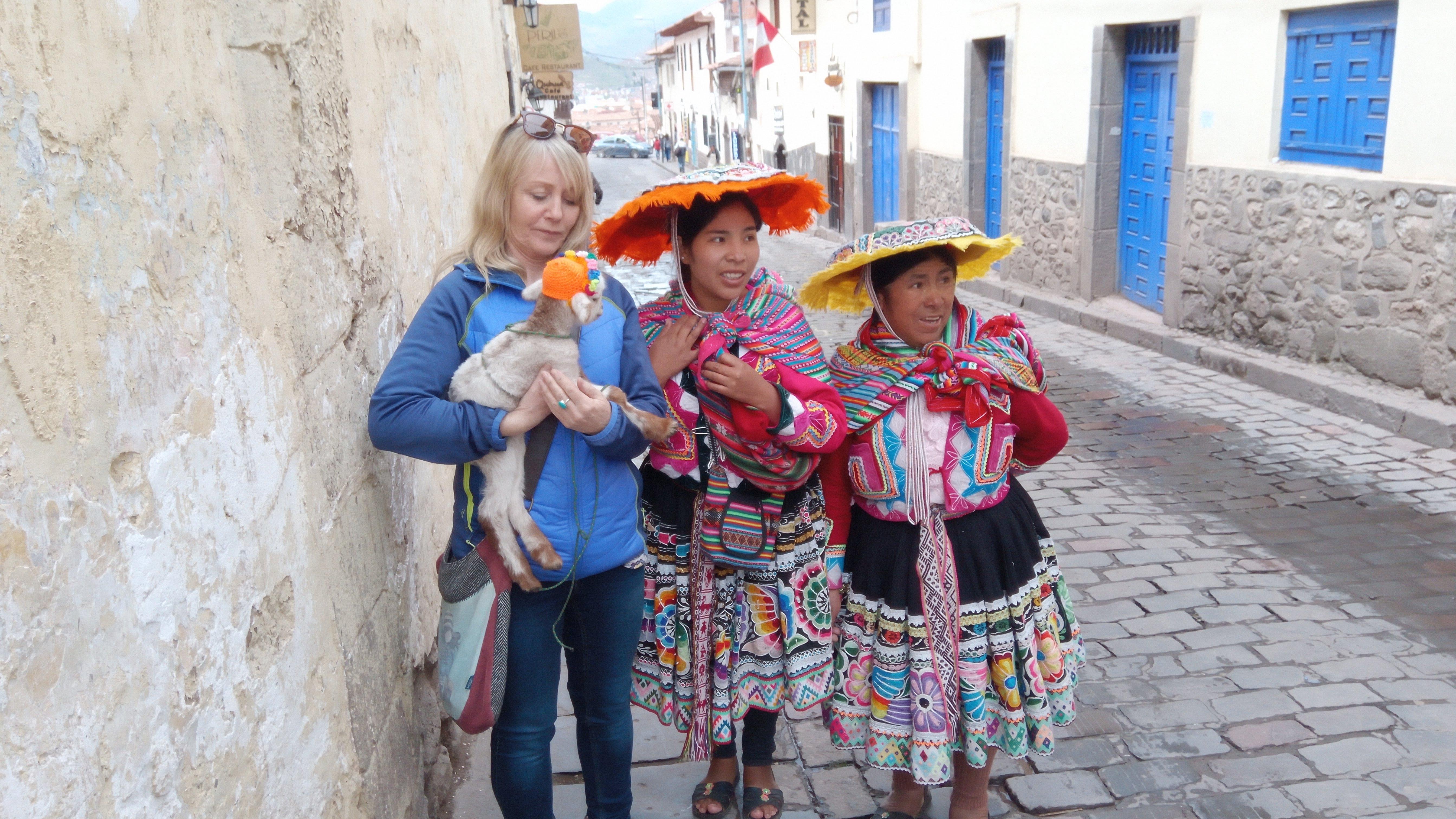
(The lamb was actually beseeching me “Take me away from all this!”)
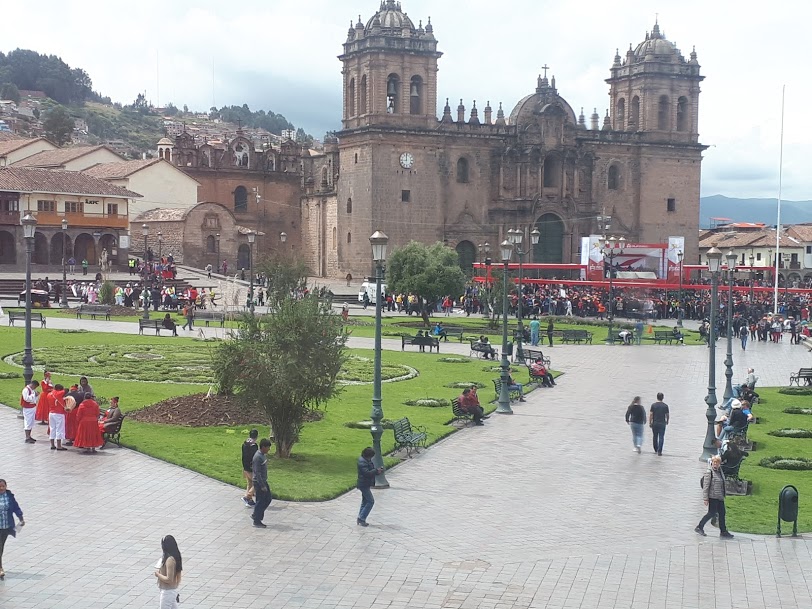
After that little tourist episode we continued our walk and within a couple of minutes we were in the Plaza de Armas which is and was the main square for the Spanish and Inca alike. There’s the imposing cathedral on one side with the beautiful church La Compania de Jesu on the street that forms a right angle to that. The other two sides of the square are lined with restaurants and shops and the architecture is obviously Spanish Colonial with stone arcades below and wooden balconies under sagging tiled roofs above.
I loved the juxtaposition of the architecture in that square. Facing the Cathedral and the church, you’re standing in a world of European Gothic with a sky line filled with elaborate tapering spires and buttresses and ornate pointed arches. Turn 180 degrees and suddenly you’ve wandered onto the set of a spaghetti western. The somewhat tumble-down unpainted buildings topped with terracotta roofs, the snaggled yet pretty disorder of things.
Beyond the town, one could see terraced hills scattered untidily with shanty houses where the real people lived. And beyond that of course the inscrutable Andes.
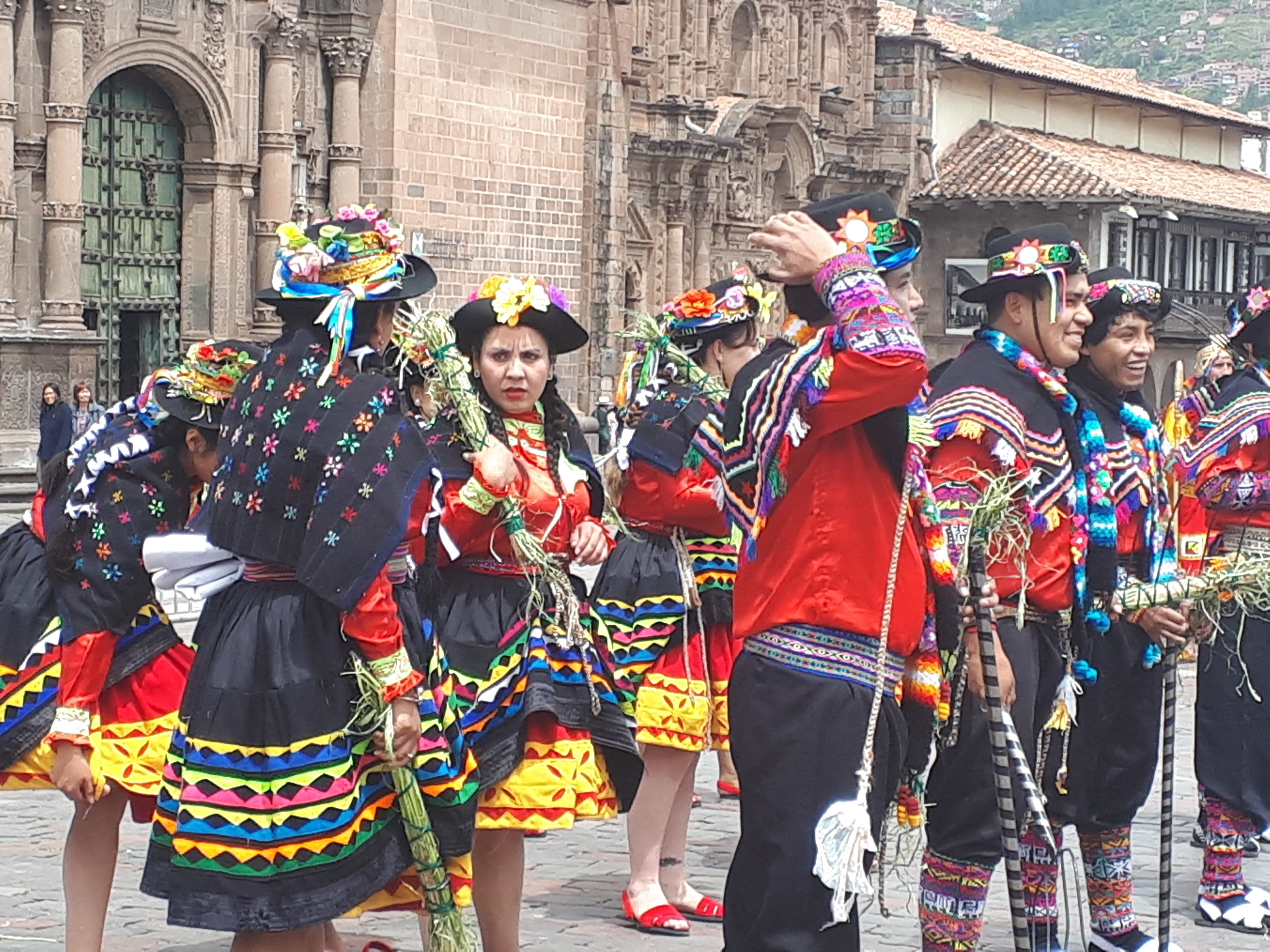
It was a bank holiday festival and the square was crowded. Apparently this square is always busy day or night. A large group of men and women in local costume were dancing before the steps of the Cathedral. The music was a din. With open arms they wheeled around in elaborate circles and the colour and vibrancy of their outfits was a sight to behold. Unique hats, hand stitched shawls and long twirling skirts on the women and all in those impossibly bright colours so associated with South America.
The two men had moved off and I stood there alone, taking it all in. The beautiful colonial buildings, the well tended lawns arranged around a fountain in the centre of the park, the pretty flowers edging the footpaths, the constant moving colour of locals and tourists rambling about. And every time I lifted my gaze there stood the mountains every which way, arranged around and beyond the town like sentries offering silent ageless protection to the people. I consider myself well travelled but had never been in a place quite like this.
I wandered around the colourful local markets. Suckersville for the likes of me. I’m very typical of the species of middle class tourist who feels uncomfortable whenever I m confronted with poverty despite the fact that I have lived and worked and travelled widely in the developing world. I meet people who have so much less than me and I want to hand over all my worldly goods, pressing money into grasping hands as if it were contaminated. This means of course that I buy things I don t need.
I met an artist – Pablo Picasso- he said his name was –an amazing coincidence- and I allowed him to lead me to a park bench splashed with sunshine where he turned over painting and after painting for my inspection. I paid far too much for two vibrantly coloured oils but I will enjoy framing and hanging them in my house in Louisburgh.
There are many such young men in Cusco, street artists hustling visitors but they are pleasant about rejection and not at all annoying. They all seem to be called Pablo Picasso and when I complained about the same name to the fourth one I met, the young guy said without breaking stride alongside me “Okay Michael Angelo then!”
I laughed and told him to go back to painting the Sistine chapel. “I think you missed a bit” I added over my shoulder and he just grinned and let me go.
Out on the street I was also offered massage, which was something I may need later. I had noticed a few stiff legged tourists wandering about, no doubt a result of the rigours of hiking one of the trails.
It was interesting what services were offered to we three gringos during our two days in Cusco.
Darren, the younger of the two men at 34, told me that he was approached by guys in the street wondering if he had a need for recreational drugs and massages. There also seemed to be an implication of happy endings. Whether this happy end would be the climax of the drug taking or enjoying a massage, I couldn’t say.
Pat and I, at 70 and 54 years young respectively, were obviously deemed too old to be peddled sex. Or drugs that weren’t for blood pressure or water retention. I was greatly offended by this.
Hey I love sex and drugs! I wanted to protest. Well it’d be nice to be frigging asked.
The markets were wonderful. The mountain artisans in Peru still employ ancient techniques producing some of the finest textiles in South America. That’s what is said in the guidebook.
I absolutely loved the colour of these textiles – wall hangings, hats, jumpers, throws. I have an undisciplined penchant for surrounding myself with a vibrant palette in my own home. Meaning I paint the shit out of everything that’s stationary. Lockers, panelled ceilings and walls, doors, beds, bookcases. All wooden surfaces cower in the face of my painting aggression. I favour the Mexican Brothel school of Interior Decor so I was very much at home in these cavern like shops where colour exploded from floor to ceiling.
I bought pencil cases and colourful hair bands that would clash with the hair of my two ginger teenagers at home. I bought a wall hanging that would look exotic in my hallway, and a pair of walking poles. (Very cheap I thought to myself but wasn’t sure. Memo to self. Do not buy stuff with foreign currency until you actually have a handle on the new money and your altitude sickness has worn off) There are lots of outdoor shops so don’t worry if you’ve forgotten to bring something for your hike.
I wandered around and smiled at people who smiled back at me and said ‘Buenos Dias Senorita’. After the 10th person called me Senorita I was puzzled. I mean I m not in the depths of decrepitude quite yet but I m clearly not a Senorita. Was this just a polite term perhaps? Or because I was woman strolling alone without a male companion?
Anyway I liked it. In fact I think I m going to insist on folks calling me Senorita when I get home. The patients in the hospital. My kids. The neighbours.
‘Ah good morning Senorita Lyons.”
“And a very good morning to you Mrs O Malley.”
Alfredo came to get us in the afternoon for a walking tour of Cusco which was hugely enjoyable. We spent over an hour in the Cathedral which was built on the foundations of an Inca temple.
The Conquistadores were in the habit of wrecking the opulent palaces and temples of the Emperors and royal families of the Inca just to build up again in the exact same place. They sought to desecrate all that was deemed sacred in the culture of another-especially pagan cultures-man they hated those pagans- and attempted to remove all traces of the Inca religion. They even took up the sand in the square and used it in the mortar for the construction of the cathedral. Seems like a scandalous waste to me. Couldn’t they have decided instead to enjoy the outrageously lavish buildings of the Inca royals with their gold studded, silver plated, emerald-dripping walls?
What is about humans with all of our amazing ability to create and invent and explore that we also seek to destroy and tear down and annihilate? All the beautiful places that we have blasted to hell. Dresden, Horoshima. Poor utterly broken Alleppo.
And to what end exactly? I’d be enormously grateful if someone could explain this to my simplistic little brain.
Maybe its time to let women run things for a while. And I m not talking about the species of ball- breaking exhausted women politicians who have to fashion themselves in men’s image to survive the cut and thrust of politics. I mean regular women with compassion and cop on. We don t have to stand in the cities holding hands and singing Kumbaya but surely surely we’d make a better hash of it?
We are more empathetic but also extremely practical. Less power hungry and violent. (In fact most of us aren’t violent at all)
There wouldn’t be so many rampaging egos to fuck everything up. Most women cannot see the sense in wars where the men they love are taken from them and killed. I haven’t noticed any women of my acquaintance who have even a remote interest in brinkmanship .
It seems to me that it’s men who are the war mongers of human kind, beating their chests and eyeing up the other fellow’s country: wife, land, ding dong, while women roll their eyes and go back to peeling the spuds.
Has a single female ever used the words “Hey! What are you lookin’ at?”
Send in the housewives I say……..
Back to the male aggressors. The Spanish Conquistadors under Francisco Pizarro defeated the Inca at the battle of Cajamarca in 1532. Pizarro had lured the emperor, the Sapa Inca Atahualpa to a meeting. The emperor arrived bristling with self importance borne aloft on his litter which was decorated in parrot feathers and silver. He was wearing his best ceremonial togs and eighty members of his royal retinue surrounded him dressed in vivid blue tunics. He naively expected to impress the Spaniards whom the Inca half suspected were Gods of some kind.
In a show of good faith, he had brought only 7000 or so of his total army of 80,000 who were camped nearby. These men were unarmed except for small knives which they wore just for show. There was attempted communication between the leaders through possibly inaccurate interpreters and there was some confusion and it is said bemusement on the part of Atahualpa who couldn’t fathom the disrespect of the Spanish, as they refused to drink the offered ceremonial chicha, an alcoholic drink made from fermented maize. I couldn’t blame him to be honest. I tasted it and it was truly gag-making awful. Eau de S bend. I would have gone to war myself rather than take another gulp.
Of course the Sapa Inca refused to adopt the Catholic faith and was incensed and indignant at the repeated insistence of the Spanish that he should do so. Thereafter the whole thing went to shit.
The Sapa Inca continued to be incensed and indignant while his men were cut down around him in a remarkably short time. The Inca had never seen fire arms used before and despite the small numbers of Spanish and the bravery of the Inca with battle hardened experience from a recent civil war, they were quickly slaughtered. Small knives and slings and expertise in hand to hand combat were no match for armoured men on horse-back with rifles.
Atahualpa was captured and had to pay a mind boggling ransom in gold and silver during his incarceration and he possibly continued to be incensed and indignant right up until the moment they executed him.
By 1533 Pizarro was in Cusco and despite a few years of attempted diplomacy and political intrigue and resistance, the Inca were defeated eventually when the last stronghold at Vilcabamba was conquered by the Spanish in 1572. Many had already died during a civil war lead by two brothers and those who were not killed in battle were wiped out by diseases brought courtesy of the Europeans. Small pox decimated the numbers of the indigenous in a way no war could achieve.
The Spanish ransacked and looted and tore everything down. The opulent palaces and temples and store houses and administrative buildings. Fate laughed at them later in the shape of earthquakes that tumbled the colonial buildings but left the original Inca structures standing. Nature thumbing its nose at man’s efforts as usual.
The Cathedral was rich with art and statutory and Alfredo, a great story teller brought everything to life for us.
It took a mere 95 years to build. Too many tea- breaks I’ll wager.
It’s also a UNESCO world heritage site and it was easy to see why. Originally a deconstructed Inca temple, the building was completed in 1654 and was built in the shape of a Latin Cross. We wandered around and through each arm of the cross in the manner of tourists the world over, gawping at this and that and stopping to listen to Alfredo’s soft spoken and humorous descriptions of what we saw.
I stopped abruptly in front of the main altar which Alfredo told us was covered in beaten silver which had been donated by a bishop in 1803. How a bishop came to be in possession of a fortune in silver taken from local mines I don’t know. Modest guy obviously. The altar was truly stunning. However I also loved the original altar behind, of course also beautifully carved but made of alder wood and more in keeping with nature as was the way of the Inca.
Alfredo took us though the cathedral for the next hour or so and showed us the eleven little chapels, the seven altar pieces, the choir area with the most intricately carved wood, the world famous art work. The partridge and the pear tree.
There was even a black Christ on the Cross who is basically a Christ that hasn’t been cleaned over the centuries and he’s ‘pure black ‘as we’d say in Ireland.
I enjoyed looking at the paintings which were from the Cusco school of art. This was a style of painting imposed by the Spanish on the local Quechua artists who were limited to painting scenes that were pleasing to the Spanish with a big emphasis on European scenes and Catholicism.
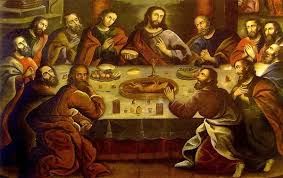
Of course despite this restriction the natives own sensibilities emerged as can be seen in the painting of the Last Supper by the native Cusco artist Markus Zapata. Unlike the original Leonardo de Vinci painting, where the plate in front of Jesus is empty, in Zapata’s depiction, Jesus and his apostles are about to dine on a rather forlorn looking guinea pig with his four legs pointing stiffly to the ceiling.
Guinea pigs are a delicacy widely eaten in Peru and Marcus Zapata must have thrown caution to the wind. (Bearing in mind that this was still the end stage of the Spanish Inquisition) However his impertinence was not punished perhaps because someone sensible decided that it would be easier to convert the indigenous natives if they used symbols from their own world. Or maybe the Spanish powers that be were busy in other parts of the world hacking off body parts and torturing non believers. Anyway there it was this quirky painting to entertain a little Irish woman all these many years later.
The Last Supper by Marcus Zapata from the Cusco School
Even if you were a person who would rather chew knives than walk around a cathedral for an hour, you could not help but be smacked in the gob by the sheer scale of human endeavour and craftsman ship that went into its’ construction.
When we went back to the square that night to dine in one of the restaurants, the plaza was even more beautiful, like a spot-lit amphitheatre with the sprinkle of lights from the houses on surrounding hills shimmering like jewels. It was easy to forget that these lights that enchanted us from afar came from the homes of people who were mostly poor.
The next day Alfredo took us on a bus tour of some Inca sites, the most interesting being Sacsayhuaman otherwise known by tittering tourists as Sexy Woman. This was a fortress to the north of the city where the Inca made their last attempt to keep control of Cusco and as I walked around the ruins under a bright brazen sun I tried to imagine the pitched battle but I couldn’t get my imagination past the sunshine and soft breeze.
The complex is constructed with massive stones that are so large and thick it was hard to conceive how they were dragged from the quarry several miles away. Sacsayhuaman is also a great example of the inventive nature of Inca construction where each stone was carved into interlocking male and female pieces that fitted together perfectly without mortar but in such a way that to this day you couldn’t fit a sheet of paper between them. The walls also lean inward slightly and the individual blocks have rounded edges, designed precisely so that in earthquakes the stones can jiggle a little in place but not become displaced. How ingenuous is that?
The sophistication of their building methods was breathtaking given the time and the absence of heavy machinery, steel, iron. They didn’t even have the wheel for godsake. They quarried these huge lumps of rock from nearby, carved protruberances onto the rocks so that they could attach ropes and then dragged these massive lumps of stone on rolling logs, goodish distances to the sites of construction where stone masons got to work. No one knows how many people it took to drag one piece of rock but it was probably in the hundreds for some pieces.
Interestingly for the time, the Inca didn’t use thousands of slaves. Their own civilians paid tax in labour and in return enjoyed the infra structure and protection of the empire.
We should do this at home. Instead of giving the government a big share of our annual income in taxes we could give a certain amount of our labour. We could all be like council workers. I could breast feed a shovel as well as the next man. Probably better seeing as how I have actual breasts.
When we weren’t sight seeing we wandered off alone or together enjoying the town and the people and the restaurants. We even made a short stop in the Irish bar but I took my own advice and didn’t drink any alcohol before the hike as I was determined not to put the kibosh on my acclimatization. We were now ready for the next and most important stage, day 1 of the Inca Trail.
 NURSE ON THE MOVE