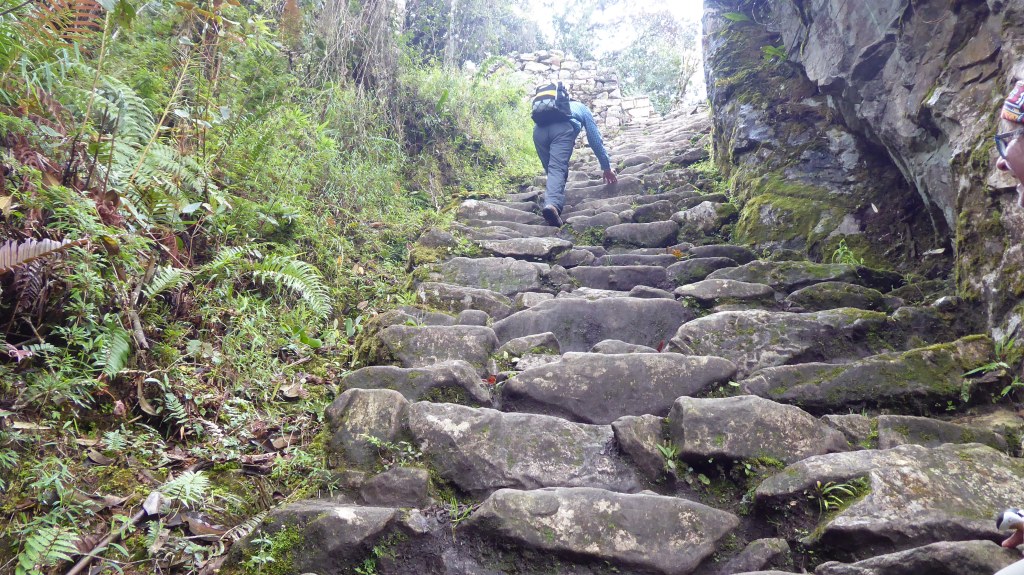
The last steep steps before the Sun Gate.
The sun gate is where it is thought that imperial guards controlled entry to the citadel of Maccu Piccu and was the primary approach into the city from Cusco. Visitors were probably restricted to royals and priests and those needed to maintain the city and serve the royals. This structure was built in homage to the sun god and was constructed in such a way as to have the rising sun pass through the gate every year on the summer solstice.
This was the end of the road for the Inca Trail travellers. For us. We had shared hugs with the porters and said our goodbyes and with just Alfredo, for the last 45 minutes or so we would follow the stone path called the sun gate trail to the city. This was also our first sighting of Maccu Piccu, a short distance away across lush mountains.
Seeing it for the first time has an overwhelming sense of unreality to it. That iconic image from a thousand pictures and post cards that we were so familiar with. However that image always had a fairy tale quality, an ephemeral beauty like the Disney Castle at the end of kid’s movies, an entity that didn’t really belong in real life.
Now we were seeing the Disney Castle for real. This was not an idealised image or chimera. The city was standing there ahead of us, aloft on it’s broad plateau, face to the heavans, bold as you like on a high mountain ridge under a warm sun, grass gleaming greenly around the stone buildings. I couldn’t take my eyes off it.
The mountains around Maccu Piccu which I fancy look like friendly ogres but that may have been the thin air speaking.
The citadel of Maccu Piccu lies well hidden on a high ridge overlooking the Urumbamba river. It is thought that construction started around 1430 and hadn’t yet been completed by 1530 when it was abandoned for reasons that are still not entirely clear. It was built perhaps as a retreat for the Sapa Inca, (Emperor or King) Pachacuti.
The site was rediscovered by the historian Hiram Bingham who was leading the Yale Peruvian Expedition to explore lost Inca sites. The Holy Grail of the expedition was the city of Vilcabamba, the retreat of the exiled last Inca king who sought refuge there for 35 years until the city was conquered by the Spanish in 1572. Over the years Vilcabamba had somehow been mislaid and Vilcabamba was The Lost City of the Incas as far as Bingham was concerned and the place he was most keen to discover. Instead he more or less stumbled on Maccu Piccu.
Other explorers had been searching for years following rumours and whispers of rumours about mystical ruins lying forgotten in the Andes but it was Bingham who got the lucky break. Perhaps it wasn’t luck. He was very energetic in making extensive enquiries of local people and then following up every single lead to every single ruin. It was one such lead that brought him to Maccu Piccu.
He had met a farmer and inn keeper in the Sacred Valley and there must have been a conversation where he asked politely ‘And tell me this, dear farmer and inn-keeper. Are there any old ruins in them thar hills?’ as he made vague gestures to the mountains above them.
To which the farmer and inn keeper must have pointed in a particular direction and answered in the affirmative. So they all set off the next day and at the top of a ridge near Maccu Piccu they met a fellow and his 11 year old boy who were farming the terraces near the site.
“Ruins anyone?” Bingham must’ve asked again.
“Yep” the boy answered. “Follow me” and Bingham followed the young fellow who didn’t show much excitement one way or the other. The boy’s name was Pablito and he was the one who first showed Bingham around the ruins which of course held no great interest for the locals. They had farmed these terraces all their lives and were probably wondering what all the fuss was about.
Of course at the time of the discovery, the site had been largely reclaimed by the jungle and the first photos taken by Bingham show Maccu Piccu well preserved but tatty with vegetation compared to the pristinely preserved site we know today.
Mr Bingham wasn’t even that impressed at first because the extent of the ruins wasn’t immediately clear.
He eventually did notch up his enthusiasm especially after he convinced himself that he had found Vilcabamba and he spent several years going back and forth to Peru, trying to make the evidence fit his theory rather than the other way around. The original analysis of the bones found at Maccu Piccu seemed to suggest that the skeletons were 80% female so Bingham concluded that these were the bones of the virgins of the sun who accompanied the Inca Kings wherever they went. So by Bingham’s reckoning the last King of the Inca had rocked up here with his virgins and lived in exile.
How lucky were these guys, the Inca Kings, carted around on feather-festooned litters trailing nubile virgins?
I can’t help thinking that The Trump would love a retinue of virgins to accompany him wherever he goes especially on trips to stuffy old Europe. It’s extremely tiring heckling heads of state and stirring up political shit storms hither and thither. I’m sure it would be very relaxing to have his brow smoothed in the evenings by a retinue of virgins after he’d had his burger.
Or. In the event that the secret service couldn’t rustle up a single virgin within the legal age, perhaps Stormy Daniels and a coterie of good time friends could accompany him instead? She seems like a gamey sort of gal and would be a lively diversion from those dreary old spoilsports, Theresa and Angela, always insisting that he discuss stultifying matters like world trade agreements and the future of Nato. I must mention the idea to him when next we meet.
Anyway poor old Bingham. He was wrong about Vilcabamba which incidentally he also discovered on the same trip had he but realised at the time.
And it turns out that the bones on future analysis were not mostly female after all just small humans. They hadn’t done any hard labour as evidenced by the lack of osteoarthritis so they were not farmers or stone masons or soldiers with a myriad of tell tale injuries to the skeleton. They were probably the royal servants, caretakers etc, the folks who flutter and fuss around Kingly persons the world over.
Still. Bingham had no reason for disappointment. Maccu Piccu became an overnight sensation and has been a marvel for the world’s pleasure ever since. Years of scientific study of the stones, artefacts, ceramics, jewellery and bones both insitu and elsewhere and careful on-going archaeological excavation by leading experts from Peru and all over the world yield ever more interesting facts about the site all the time.
Its’ elevation is 2430 meters and it can only be seen from high up in the mountains which is why it was never discovered by the Spanish although it was only 80 km from Cusco. If the Spanish had found this estate it would have been destroyed as per colonial policy at the time.
We walked along the sun gate path to a large platform over the city. We would not visit the complex proper until the following day which I was pleased about because I wanted to feel refreshed and clean when we finally got there.
After an hour or so of gazing down into the pristine site and a bit of oohing and a lot of ahhing, we climbed into a big bus that took us rumbling down the switch back roads to the town of Agua Calientes where we would spend the night before returning to see Maccu Piccu at dawn to properly explore the ruins.
 NURSE ON THE MOVE